Views: 0 Author: Site Editor Publish Time: 2026-01-06 Origin: Site


Suspended platforms are essential for accessing high-rise buildings and tall structures safely. These platforms are widely used in construction, maintenance, and cleaning, where traditional scaffolding falls short. Understanding the different types of suspended platforms is crucial for worker safety and project efficiency. In this article, we will explore the various types of suspended platforms, their benefits, and key considerations to help you select the best option for your project needs.
A single-point suspended platform is one of the simplest types of suspended scaffolding. It is supported by a single rope or cable, with the platform typically hanging from a single overhead anchor point. This design makes it lightweight and highly maneuverable, offering easy mobility in confined spaces or areas that require access from one specific point.
Single-point suspended platforms are most commonly used for tasks such as window washing, minor repairs, or inspections. These tasks often require access to one specific area, making the single-point design an ideal solution. For example, window cleaning on skyscrapers is efficiently done with this type of platform, especially when only one worker is needed.
Advantages: Single-point platforms are lightweight, cost-effective, and easy to maneuver. They provide flexibility, allowing workers to reach specific areas without requiring large equipment.
Disadvantages: These platforms have limited load capacity and are generally suitable only for light tasks. Additionally, the single anchor point increases the risk of failure if not properly managed, requiring thorough inspections before use.
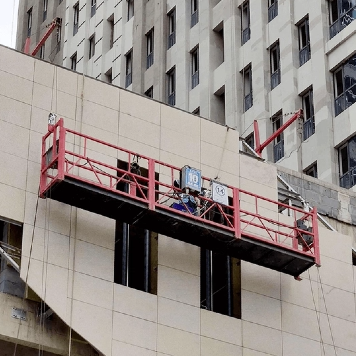
Two-point suspended platforms, also known as swing stages, are the most commonly used type of suspended scaffolding. These platforms are suspended by two ropes or cables, one at each end of the platform. This design provides greater stability, allowing for a more secure and versatile work environment, especially for tasks that require heavier loads.
Two-point systems offer better stability and are motorized, making it easier to adjust the platform’s height. This motorization allows workers to access hard-to-reach areas safely and efficiently, such as building facades, where continuous height adjustments are necessary. This type is especially useful for window washing, exterior maintenance, and facade painting in high-rise buildings.
Two-point suspended platforms are widely used in construction and maintenance tasks that require precise access to elevated areas. The following table outlines the key applications, considerations, technical specifications, and operational guidelines, providing a comprehensive look at how these platforms can be effectively used for high-rise projects and large-scale repairs.
| Category | Details |
|---|---|
| Applications | - High-rise construction, facade repairs, large-scale exterior painting, window washing. |
| Key Features | - Dual-anchor suspension for stability. |
| Load Capacity | - Supports heavier loads compared to single-point systems. Can carry tools, materials, and multiple workers (typically up to 500 kg). |
| Height Adjustment | - Motorized systems for precise height control, suitable for projects requiring frequent repositioning. |
| Wind Sensitivity | - More stable than single-point platforms, reducing swaying in high wind conditions. |
| Safety Features | - Requires both guardrails and personal fall arrest systems (PFAS) to comply with safety standards. |
| Efficiency and Productivity | - Allows workers to access multiple heights quickly, improving overall productivity in large-scale projects. |
| Setup and Installation | - Easy setup with motorized hoists, but requires precise anchor placement. |
| Considerations | - Requires skilled operators to handle wind challenges and frequent height adjustments. |
| Environmental Impact | - Minimal environmental footprint as it uses fewer materials than traditional scaffolding, making it cost-effective for long-term use. |
Tip: Regular inspections are essential to ensure safety when using two-point suspended platforms, especially in windy conditions. Always check the anchorage points for stability and ensure proper training for operators.
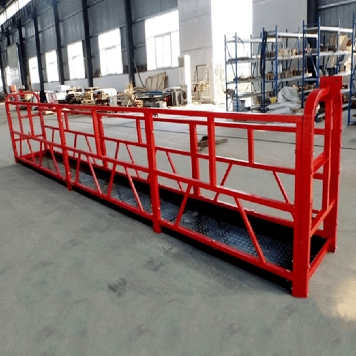
Multi-point suspended platforms distribute weight across multiple anchor points, typically using three or more ropes or cables. This design enhances stability and load-bearing capacity, making them suitable for high-demand tasks. Research indicates that the multi-anchor system reduces sway and improves platform control, offering better support for heavy materials and equipment compared to simpler systems.
These platforms are ideal for large-scale construction and industrial maintenance, particularly in complex, irregular environments. Their ability to support multiple workers at different heights enhances productivity, particularly in facade renovations or bridge inspections, where precise, simultaneous access is necessary for efficiency and safety.
Advantages: Multi-point systems provide higher load capacity, allowing multiple workers and heavy materials to be supported. The multiple anchor points reduce sway, increasing overall stability.
Disadvantages: The setup of multi-point systems can be more complex, requiring additional time and skilled labor for installation. The higher operational costs also make it less cost-effective for small-scale projects.
Catenary suspended platforms consist of a platform supported by two horizontal, parallel ropes. These ropes are suspended from structural supports, such as beams and columns. The platform is stabilized with hook-shaped stops to prevent it from slipping off the ropes, offering a stable and wide-span working platform.
Catenary scaffolding is commonly used in industrial settings, where a fixed horizontal path is required, such as during the construction or maintenance of long bridges or similar structures. It is also used in situations where overhead supports are spaced too far apart for traditional systems.
Advantages: Catenary platforms are ideal for spanning large distances, offering a stable workspace in environments with limited vertical support.
Disadvantages: These platforms are not adjustable in height, limiting their flexibility. The setup is also more complex and requires careful consideration of the structural supports.
Float scaffolding consists of a platform suspended by fixed-length ropes, supported by two parallel bearers. This design allows the platform to move horizontally along the beam, offering workers access to various areas along a structure, such as building facades or industrial units. Studies have shown that this type of scaffolding is highly efficient for light-duty tasks, providing both stability and ease of movement. However, its fixed height limits its use in tasks requiring frequent elevation adjustments. The platform’s lightweight structure makes it cost-effective and ideal for short-term, smaller-scale projects.
Float scaffolds are often used for small-scale tasks that require fixed-height access. The following table outlines their ideal applications, key features, limitations, and operational guidelines, providing a comprehensive look at when and how to best utilize float platforms for efficient, safe operations.
| Category | Details |
|---|---|
| Applications | - Small maintenance tasks like painting and light inspections. |
| Best Fit for | - Facade maintenance on buildings, industrial structure upkeep, and tasks where height flexibility is unnecessary. |
| Fixed Height | - Float platforms are not adjustable, making them suitable only for tasks at a single, fixed height. |
| Load Capacity | - Generally supports up to 3 workers with light tools and materials; not suitable for heavy loads. |
| Mobility and Setup | - Easy setup with minimal equipment, ideal for quick, low-complexity tasks. |
| Key Features | - Simple design, minimal setup complexity, and cost-effective for short-term, small-scale projects. |
| Advantages | - Cost-effective, quick deployment, and minimal disruption to ground-level operations. |
| Disadvantages | - Limited to fixed heights; unsuitable for tasks that require height adjustments or heavy loads. |
| Safety Considerations | - Requires standard fall protection measures (e.g., harnesses), as well as proper inspection of ropes and attachments. |
| Operational Guidelines | - Ensure the platform is securely anchored and the ropes are free from wear or damage. Regular inspections before use are critical. |
Advantages: Float platforms are easy to set up, cost-effective, and efficient for light-duty tasks. Their fixed-length ropes make them simple to operate, with less equipment needed compared to other types of suspended platforms.
Disadvantages: The lack of height adjustability makes these platforms unsuitable for tasks that require frequent elevation changes. They are also limited to lighter loads and are not ideal for more extensive maintenance tasks.
Interior hung scaffolding is designed to suspend a platform from the ceiling or roof using fixed-length ropes or cables. This design is beneficial in buildings with limited floor space, where traditional scaffolding cannot be used. Its fixed height requires a stable overhead structure, such as ceiling beams or rafters, to ensure safety and reliability. Studies have shown that interior hung scaffolding is highly effective in reducing floor space clutter while providing necessary access for indoor maintenance tasks.
Interior hung scaffolding is commonly used in environments where ground-based scaffolding is impractical, such as during HVAC installation, painting, or repairs in large indoor spaces like theaters, churches, or warehouses. Its flexibility allows for access to difficult-to-reach areas like high ceilings or narrow aisles, improving efficiency and reducing disruption in busy facilities. This system is especially suitable for tasks requiring precision and stability without occupying valuable ground space.
Advantages: Interior hung platforms are stable, offering reliable support for indoor tasks. They are ideal for repetitive work in controlled environments like industrial facilities.
Disadvantages: The fixed height of the platform limits its use for projects that require flexibility. It also depends on the integrity of the ceiling or roof structure for support.
Multi-level suspended platforms are designed with multiple work surfaces suspended at varying heights, all supported by a common stirrup system. This unique design allows workers to simultaneously access several areas on a building’s facade or structure, enhancing productivity. Studies highlight that these platforms reduce the need for repositioning, making them ideal for large-scale projects where time efficiency and accessibility are crucial. Their ability to provide stable access at different heights contributes to improved safety and operational flow.
Multi-level suspended platforms are essential in large-scale construction, renovation, and facade maintenance projects. They are particularly beneficial when multiple teams need to work at different elevations, such as in the construction of tall buildings or skyscrapers. These platforms enable simultaneous work across various levels, improving coordination and reducing downtime. By eliminating the need to reposition scaffolding, they enhance operational efficiency and ensure that large-scale tasks are completed within tighter deadlines.
Advantages: Multi-level systems offer increased productivity by accommodating multiple workers and tasks at different heights simultaneously. This setup is ideal for complex projects with high demands.
Disadvantages: The complexity of the setup requires precise calculations and skilled labor. The costs associated with multi-level scaffolds can also be higher due to the increased equipment and labor requirements.
The boatswain’s chair is one of the simplest types of suspended platforms, designed for single-worker use. It consists of a small seat or platform suspended from a single overhead rope, allowing the worker to be safely lowered or raised to various heights. This compact design is lightweight and highly mobile, making it an ideal choice for tasks in tight spaces where larger scaffolding systems would be impractical. Research supports that boatswain’s chairs are particularly effective in reducing setup time and minimizing space disruption in high-rise environments.
Boatswain’s chairs are commonly used for light tasks such as window cleaning, minor inspections, and repairs on high-rise buildings. Their small size and mobility make them perfect for confined spaces or areas that require quick access. This type of suspended platform is often deployed in situations where traditional scaffolding cannot be set up quickly, such as for emergency maintenance or when working on narrow surfaces. Its lightweight nature makes it an ideal solution for quick, focused tasks that do not require heavy load capacity.
Advantages: The boatswain’s chair is extremely lightweight, portable, and easy to use, making it perfect for quick, short-duration tasks.
Disadvantages: It has limited capacity, can only accommodate one worker, and is not suitable for tasks requiring heavy lifting or larger teams.
Suspended platforms come in various types, each tailored to specific tasks and project needs. From lightweight single-point platforms for minor tasks to multi-point systems suited for large-scale projects, selecting the right suspended platform is crucial for ensuring worker safety and operational efficiency. Nantong Haibao Construction Machinery Co., Ltd. offers a range of suspended platforms designed for safety, reliability, and ease of use. Their platforms, like the ZLP series, provide exceptional stability and versatility for tasks ranging from façade maintenance to window cleaning. Whether your project requires mobility or heavy-duty support, Nantong Haibao Construction Machinery Co., Ltd. ensures you get the perfect equipment to meet your requirements.
A: A suspended platform is a temporary work surface suspended from a building’s roof or upper levels, typically used for construction, maintenance, and cleaning tasks on high-rise buildings.
A: Suspended platforms are suspended by ropes or cables, allowing workers to access elevated areas safely. They are often motorized for height adjustments and are equipped with safety features like guardrails.
A: There are several types of suspended platforms, including single-point, two-point (swing stage), multi-point, catenary, and float platforms. Each type is designed for specific tasks and load capacities.
A: Two-point suspended platforms, or swing stages, offer better stability and mobility for tasks like facade repairs and window cleaning, making them ideal for high-rise maintenance.
A: The cost of a suspended platform depends on factors like its type, load capacity, and project duration. Generally, multi-point systems are more expensive due to their higher load capacity and complexity.